Kameayaori's Unique Characteristics
Currently, "Shinjo Kameayaori" is registered as an intangible folk cultural property of Shinjo City, Yamagata Prefecture (registered in 2020).
As a specialty product deeply rooted in Shinjo’s history, Kameayaori is popular as a souvenir, gift, or thank-you gift for hometown tax donations.
Highly Advanced Hand-Weaving Techniques
In a standard flat weave, warp and weft threads alternately pass over and under one another, forming a basic fabric structure composed of intersecting vertical and horizontal threads.
In contrast, Kameayaori is woven using a technique known as twill weave, in which the threads are arranged diagonally. In a simple twill weave, a single weft thread passes over and under three or more warp threads. In some Kameayaori patterns, dozens of threads intersect in highly complex combinations.
These woven patterns are created by stepping on treadles beneath the loom in precise sequences, a process that demands exceptional technical skill and intense concentration.
Kameayaori is woven with extremely fine raw silk and requires strong, continuous tension and weaving force. For these reasons, even an experienced weaver can produce only 20–30 centimeters per day. Weaving a single bolt of kimono fabric may take approximately four months from planning to completion, including preparatory processes such as starching the threads.

An Exquisite Texture Achieved Through the
“Post-Degumming” Process
A defining characteristic of Kameayaori is that it is traditionally woven using untwisted raw silk.
The fabric is woven with the silk’s natural starch coating (sericin) still intact and is removed only after weaving, a method known as post-weaving degumming. During this process, the sericin is washed away, allowing the warp and weft threads to become plump and relaxed.
This post-weaving refining gives Kameayaori its distinctive softness, elegant luster, and supple texture, creating a fabric that feels remarkably light despite its visual richness.

A Multitude of Restored Woven Patterns
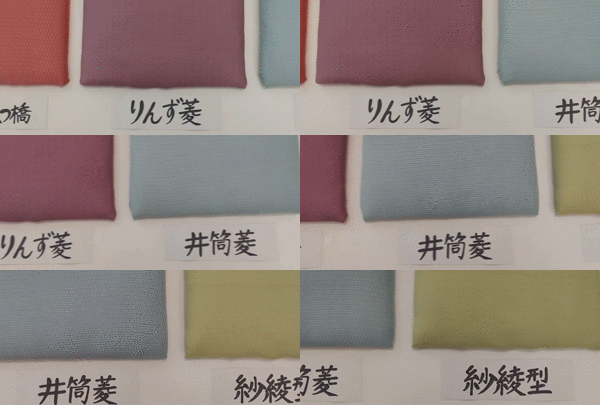
At its peak, over 30 different types of Kameayaori were woven, but currently few historical clues exist to determine with certainty the exact number of fabric types woven at the time. Remaining historical texts refer to names such as sayagatahishi, ajiroori, kamokameori, and yatsuhashiori. These names are believed to have been derived from differences in weaving techniques, specifically the fabric structures formed by the interaction of warp and weft threads within each pattern.
From the Bunsei era of the Edo period, Kameayaori was promoted as a specialty product of the Shinjo domain, but production was temporarily suspended after the fires of the Boshin War decimated the tools used for silk production. Through the establishment of vocational schools, repeated revival attempts were made; however, production of Kameayaori eventually ceased at the end of the Meiji period, earning it the moniker “The Mythical Textile.”
As part of the Mogami Model Settlement Area project launched in the 1980s, further attempts were made to restore the weaving methods of "Shinjo Kameayaori," a local specialty of the Mogami Region. Through research into fabric remnants and historical weaving texts, over 10 types of weaving were restored, including the traditional pattern sayagata.
Currently, the Traditional Culture Association attempts to further restore traditional weaving patterns while adding new interpretations based on documents believed to have been produced around the Taisho period.
Until recently, only small items made from Kameayaori fabric had been commercialized. Unfortunately since its establishment, the number of weavers at the Association has dwindled from 10 to 3. In the future, the Association plans to increase its staff in order to allow its weavers to concentrate on their weaving tasks and projects. The Association is also currently accepting reservations for the production of custom bolts of kimono or obi fabric made-to-order.